Do people give more respect to individual contributors or leaders? Said another way, do employees generally respect their bosses more for being able to do the work they do as individual contributors …. or to lead the work? For example, do you think most engineers respect their bosses for their engineering abilities or leadership abilities? Do most technicians respect their bosses for their technical abilities or their leadership abilities?
A belief held by some bosses is they should be able to do whatever work their teams do. They say “I want my team to know I’m willing and able to do whatever they do.” They believe their ability to “do real work” is what their employees most respect and potentially what makes them most valuable as the boss. (Note that “real work” is the work routinely done by the individual contributors.)
This makes sense in cases where leaders are paid to be the subject matter experts and do real work. Doctors are an obvious example. Great doctors may be responsible for leading a staff, but are expected to be the expert and primary contributor. Lawyers, pastors, and consultants, as other examples, often lead a staff of people too, but “do real work.” They are typically paid for the work they do in contrast to the work done by their staff.
In most other environments, where leaders manage people who do the work, is the leaders’ value really in their ability to do the real work? In the technician example above, do managers over departments of technical employees contribute more value when they do technical work or when they are helping their employees do the technical work?
Maybe the best example to consider is in sports. What impacts a sports team more – a great player or a great coach? More fundamentally, can a team be a great team without a great coach? Which adds the most value to the team’s performance—one individual’s contributions or the collective contributions of the whole team under the leadership of a coach?
There are some bosses who don’t know what else they would do if they didn’t do the work of their team. They were typically promoted into their manager role because they were a great individual contributor, but never stopped being an individual contributor.
What else might a boss might do beyond doing real work? Assuming a boss is a great boss, or let’s say a leader instead of a manager, there are many ways they contribute value. Fundamentally, great leaders help their people be successful. They advocate for them. They coach them and help them overcome obstacles. They guide, exhort, motivate, and inform their people. They also hold them accountable. Ultimately, great leaders create a team of people who are self-sufficient and take care of the real work. Then, in addition to helping their people be successful, great leaders provide strategic value in areas such as attracting top talent, improving processes, and developing new opportunities.
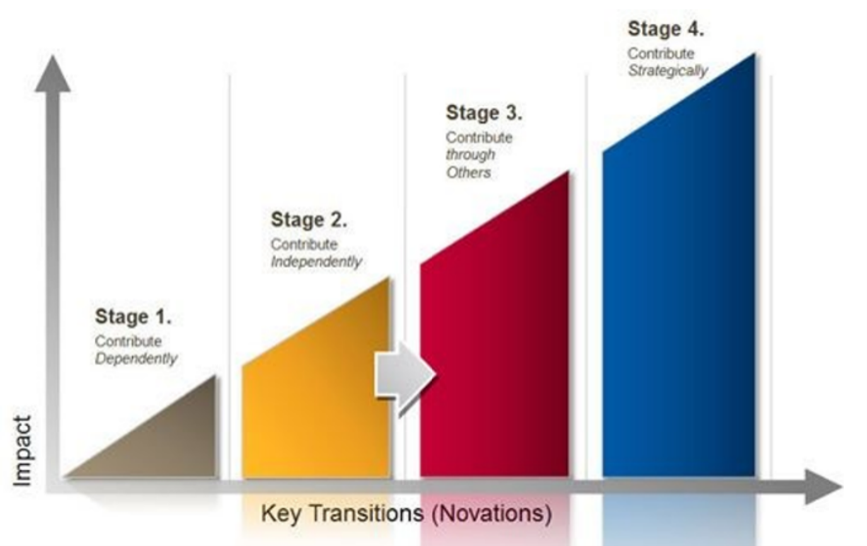
There is a framework called The Four Stages of Career Contribution that puts people’s contributions into a formula. The framework was popularized by the consulting group Novations which was acquired by Korn Ferry. The framework reflects the four stages of increasing impact a person’s contributions have as they take on more responsibility and exert more influence. The underlying principle is that the more people you positively influence, the more value you contribute. On one end of the scale, when you work in the role of an individual contributor, you are impacting one person—yourself. On the other end of the scale, when you provide leadership, you impact the work of all the people within your circle of influence.
To be clear, you can be a leader and influence many people without being a boss. Leadership is a trait, not a title. The key difference between being an individual contributor and a leader isn’t in how many people you manage, but rather in how many people you influence. Leaders, regardless of title, influence others. They think and act strategically. Through their knowledge and effort, they increase other’s knowledge and ability. They help others be the best they can be. They help others be successful.
If interested in better understanding and assessing your potential as a manager of people versus a master of a domain, visit https://alpinelink.com/Docs/Management_vs_Mastery_Potential_Assessment.pdf.
If interested in knowing more about the job responsibilities of a great leader, beyond doing “real work”, visit https://alpinelink.com/docs/The_Job_Description_of_a_Great_Leader.pdf.
Listed below is the framework with the formulas for the four stages of career contribution. The definitions provided for each stage are sourced from Book One of the SCOPE of Leadership six book series Leadership Competencies that Enable Results.
- Dependent Contribution: Dependent contribution is the learning stage, where your value (V) equals your contribution (Y) divided by the number of others (n) helping you deliver your contribution. The formula for dependent contribution is V = Y / n. In other words, the more help you require from others in order to perform your work, the lower the net value that you produce.
- Independent Contribution: Independent contribution is the domain expertise stage, where your value equals your contribution. The formula for independent contribution is V = Y. When you become a self-sufficient individual contributor, your direct contribution equals the value you produce.
- Contributing through Others: Contributing through others is the local leadership stage, where your value equals your contribution multiplied by the number of people (n) within your direct sphere of influence. The formula for contributing through others is V = Y × n. The more people you positively influence, the more value you produce. Studies find that over 80 percent of people who contribute through local leadership are not in management positions.
- Contributing Strategically: Contributing strategically is the shaping the organization stage, where your value equals your contribution raised to the power of the number of people your contribution influences. The formula for strategic contribution is V = Yn. This represents the exponential effect of leadership. Your direct influence impacts people, who in turn impact other people, who impact other people. Contributing strategically means your influence is no longer localized to the people you work with directly. Your influence is extended across geographies, industries, families, and generations. Studies find that 65 percent of those who contribute strategically are not in management positions. They are masters of competencies and knowledge who influence others through their thought leadership.
PDF version of this article: https://alpinelink.com/docs/Are_You_More_Valuable_as_a_Boss_or_Individual_Contributor.pdf.
