If you were hiring a subcontractor to work on your house, a mechanic to work on your vehicle, a doctor, a counselor, or an employee, what trait would you look for? Work ethic? Intelligence? Honesty? Kindness? Knowledge? Experience?
Most people try to hire someone with as many of these traits as possible, but prioritize experience above the rest. Experience is what people picture in their mind when they think about competence and capability. The bigger the problem people need help solving, the more experience they look for. The more they give attention to how much time someone has worked in a particular field.
But is time in a given field of work the best attribute to look for? Are the number of years a doctor has been in practice or a salesperson has been in sales the best validation of their ability? What if a salesperson, for example, took orders for twenty years instead of proactively going after new clients, learning how to sell better than the competition, and developing the skill of great customer service? Wouldn’t a “less experienced” salesperson with a more proactive, competitive, and customer focused capability be more qualified?
The attribute that makes people more qualified isn’t merely the time spent doing something. Neither is it their knowledge. Knowledge doesn’t guarantee ability. Being qualified is more about the amount of learning someone has gained from application, practice, and on-the-job experience. Being qualified is more about the problems, challenges, and adversity a person has engaged and overcome than the time they’ve spent doing something.
We pursue a life of prosperity with as much success, comfort, convenience, and fun as possible, but easy street is a poor teacher. The challenging circumstances and adversity we encounter is what provides life’s lessons. It is through complexity, conflict, mistakes, embarrassment, discomfort, and failure that people learn, mature, and gain wisdom.
This is not to suggest that you should strive to make mistakes or pursue failure, but when you experience it, learn from it. If you can embrace this philosophy, you can get to the point of being glad for your adversity. You can appreciate the discomfort, embarrassment, and frustration by knowing you are learning and improving. You can feel encouraged that you will be better for your challenges and better able to help others through them.
Studies on success find that everyone experiences adversity. Yes, some more than others, but the people who are most successful in life are the ones who choose to learn from their adversity rather than be a victim from it. You can either be better from adversity or more helpless. The people you want to hire, and hopefully be, are those who had the experience AND learned from it.
If you’re not convinced of the necessity of experience with its associated learning, versus having knowledge, consider these questions: Would you engage a psychologist for your children who has thousands of hours of practice, but never had children? A child psychologist who never lived with kids in their terrible twos? Or with rebellious teenagers? Would you hire a career coach, executive coach, or business coach who only studied in academia? Or only had one job? Who would be more helpful—a coach who had one job in one role or one who had worked through many challenging issues with many organizations at many different levels?
The more lessons you’ve learned, the more qualified you become. The wiser you become. If you want to hire someone with the highest degree of ability, rather than focus on their tenure, knowledge, or successes, ask them about their hardships, mistakes, and failures. Ask what they’ve learned through their adversity. Of course, success often involves overcoming obstacles, but not always. There have been many successes based more on luck than being good.
To learn from your adversity, immerse yourself in it. Explore and understand it. Get beyond the observable symptoms and expose the root causes. Discover all the relevant contributing circumstances. Ask for other’s input and feedback to help offset any biases, rationalizations, or inaccurate perceptions. Identify the areas you influenced, what you did well, and what you might have done differently. Record what you learned and plan to do differently in the future while it is fresh on your mind. In other words, hit the save button instead of the delete button on your lessons learned.
If you are going through adversity, or have a track record of adversity, don’t be ashamed by it. You may feel like a failure, but don’t. You may have made many mistakes, but that doesn’t define you unless you let it. Instead, reframe what you’ve been through. Be glad for it rather than disappointed. If you’ve learned from it and continue to learn from it, be proud that you’ve been through it, learned from it, and are better for it. Your learning from the past is what gives you the most valuable experience and wisdom.
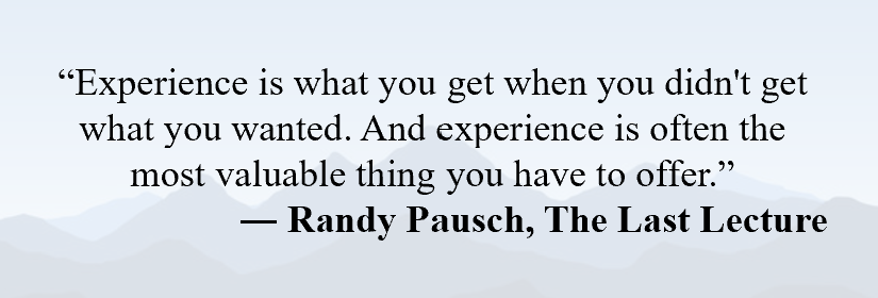
As Randy Pausch, the Carnegie Mellon professor, said in his inspirational memoir The Last Lecture, “Experience is what you get when you didn’t get what you wanted. And experience is often the most valuable thing you have to offer.”
If you want to be smart, or as good as artificial intelligence (AI), read as much as you can. Go to school and attend seminars as often as you can. Talk to others, watch videos, and listen to podcasts as much as you can. Increase your knowledge as much as possible.
However, if you want to be wise and better than AI, not only increase your knowledge, but put yourself in challenging circumstances. If you want to increase your value to your employer, your team, or your family, apply yourself. Put your knowledge into practice. Take initiative. Put yourself at risk of making mistakes. Risk being embarrassed. Be the player who constantly practices “put me in coach” rather than a spectator.
The concept of applying yourself and taking action is perhaps most famously articulated by Theodore Roosevelt, the 26th president of the United States, serving from 1901 to 1909, who said:
“It is not the critic who counts; not the man who points out how the strong man stumbles, or where the doer of deeds could have done them better. The credit belongs to the man who is actually in the arena, whose face is marred by dust and sweat and blood; who strives valiantly; who errs, who comes short again and again, because there is no effort without error and shortcoming; but who does actually strive to do the deeds; who knows great enthusiasms, the great devotions; who spends himself in a worthy cause; who at the best knows in the end the triumph of high achievement, and who at the worst, if he fails, at least fails while daring greatly, so that his place shall never be with those cold and timid souls who neither know victory nor defeat.”
This is not to ignore the importance of intelligence, education, work ethic, or people’s future potential. If you have the time and opportunity to onboard a high-potential person who will become experienced and wise at some point, do it. No one is born experienced and wise. Give people the chance when you can. But if you need someone on your team now to get something critical done now, especially something challenging, look for the wisdom and capability that only comes from lessons learned. Surround yourself with players, not merely those who watched the games.
PDF version of this article: https://alpinelink.com/docs/Lessons_Learned_Make_You_Valuable.pdf.
