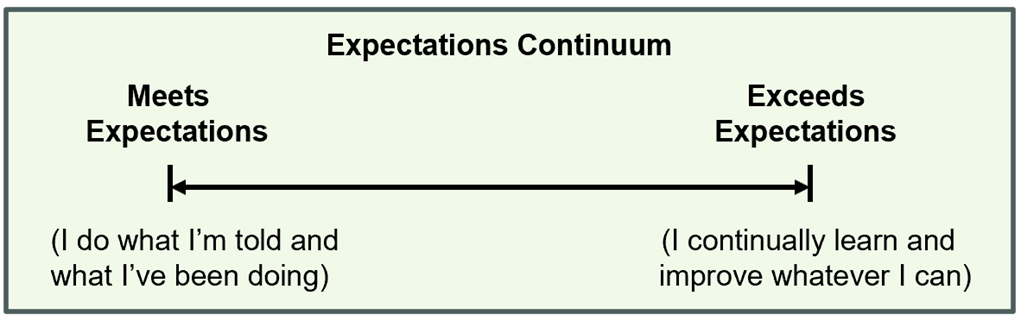
Most organizations with more than a few employees have a performance management system that rates people on how well they achieve their goals. As part of the system, employees receive a rating that reflects the extent to which they missed expectations, met expectations, or exceeded expectations.
This isn’t just a workplace practice. Schools measure how well students perform. Parents are less formal about it, but they too have expectations of their kids that result in perceptions of achieving, not achieving, or exceeding in some way.
Whether we like it or not, we grow up, live, and work in a performance culture. This has many implications. One, is that it guides people in what to do. Another, is that it influences how people are paid. It also impacts how people are treated and the extent to which they are respected. Another is that it tends to nudge, if not force, people toward that which they are best able to do.
However, some people get comfortable in roles in which they are not best suited. They settle into roles and habits in which they may be able to do, but not excel. They are able to meet expectations, but not exceed them. Reasons for this vary. Some lack passion for the work. Some reach the limit of what they can do. Others become complacent and don’t want to deal with changing what they do.
What do you think about employees who become complacent in their jobs? Let’s say they “meet expectations” but never exceed them, with meeting expectations meaning “they do what they are told as long as the work remains about the same as what they’ve been doing before.”
Is simply meeting expectations okay? If you are a manager, is it okay for an employee to show up at 8:00am, do what is minimally expected, leave at 5:00pm, and “meet expectations?”
Before you answer, here are a few other details. This employee doesn’t question what they do. They are not curious about why they are doing what they do. They don’t have any desire to gain new knowledge or develop new skills. They don’t care to increase their productivity. They don’t want to improve how things are done. They don’t offer any new ideas. They just want to go to work, meet expectations, and get paid without putting in any more effort than what is minimally required.
By the way, this behavior reflects the current definition of “quiet quitting” where an employee has no ambition in their current role, takes no initiative, has no passion, is unmotivated, and is mostly disengaged. As a result, they don’t give their best. They don’t put in any discretionary effort above what is minimally required. They dodge accountability as much as possible. They don’t get out of their comfort zone.
If people don’t have the ambition to do more, help more, or learn more, how can they keep up? Whether they like it or not, the world isn’t a static place. Nor is their workplace, community, or home. Organizations change. Technology changes. People change. Investments change. Health changes. Virtually nothing stays the same.
How can an organization with complacent people keep up with changing market conditions? Changing customer requirements? System changes? New trends? New methods? New competitors? How does a company that maintains low standards of performance compete with others that have higher standards?
While “meeting expectations” may seem okay, it certainly isn’t when it enables complacency. No person or organization can simply keep doing what they’ve always been doing and not fall behind. Ask Kodak. Ask Sears. Ask Blockbuster. Ask Yahoo. Ask AOL and countless other companies that didn’t lead or adapt to change.
To be clear, this isn’t to suggest that employees have to go to the other extreme. Employees shouldn’t sacrifice themselves or their families to their work. Nor do they need to make work their top priority. Nor do they have to wear themselves out trying to keep up with every new idea that comes along.
Where do you land on the “expectations continuum?” What is your philosophy in regard to doing more than is minimally expected? What example do you strive to set for others in your sphere of influence? Are you a person who “does what I’m told” or “continually learns and improves whatever I reasonably can?”
There are several well-known and successful people such as Napoleon Hill and Zig Ziglar credited with the quote “go the extra mile by rendering more service and better service than you are now being paid for.” You probably don’t need to look any farther than your own experience to find people who go above and beyond what is expected of them to validate the impact of doing this. But what does it mean? Why should we do more than is required of us?
Going the extra mile helps us and others. It makes us better. It makes those around us better. It makes our organizations better. It makes the world better. Thankfully, many people before us didn’t merely accept the status quo in terms of transportation, communications, education, power, security, healthcare, and so on.
By the way, the original source of the extra-mile quote is from the bible where Jesus said in Matthew 5:41, “If anyone forces you to go one mile, go with them two miles”. This was in reference to a Roman law at the time allowing Roman soldiers to force citizens to carry their gear for one mile. Jesus’ instruction to his followers was to offer to carry the soldiers’ gear for a second mile.
If you want to remain relevant, and thrive rather than merely survive, and help others thrive as well, embrace a growth mindset. Look for opportunities to learn more, do more, and help more. Don’t settle for less than your best. See change as an opportunity rather than a threat. Take initiative to identify improvements in yourself and your environment. Look for problems to solve and opportunities to leverage. Be a disrupter. Challenge the status quo. Be a leader. Give a little extra effort in your work and relationships. Drive the bus on the journey of improvement, or at least get on it, rather than get run over by it.
PDF version of this article: https://alpinelink.com/docs/Is_Meeting_Expectations_Okay.pdf.
