Have you ever found yourself stuck in a thought or feeling you knew was unhealthy, but you couldn’t stop it? Maybe you were unable to think of someone more positively. Maybe yourself. Or you couldn’t override a fear or calm an anxiety you knew didn’t deserve the negative energy you were giving it.
The most powerful ability we have as humans is the ability to think about our thinking. Yet this metacognition ability can also be frustrating. We sometimes think more than we want to. Thankfully, though, this ability can also help us change our thinking.
Because our ability to think about our thinking is so powerful it is also one of the most challenging to use. If you’ve ever thought to yourself “why am I letting this bother me so much?” or “why can’t I change how I think about this?” you know how challenging it can be.
Our brain is powerful, but complex. We know a lot about it through significant advancements in modern-day neuroscience, but we still have a lot to discover. We know the functional parts of our brain, where our thoughts, feelings, and memories reside, but the intricacies of exactly why and how are still being discovered.
One simple explanation of our brain’s functionality is based on the right vs left side. Our right hemisphere is predominately focused on feelings and relationships. Our left hemisphere is predominately focused on logic and problem solving. Some people are predominately right-brain oriented and some are left-brain. There are many personality assessments that help people know which is their predominate preference. Of course, all people have both halves of their brains which means everyone has the ability to both think and feel.
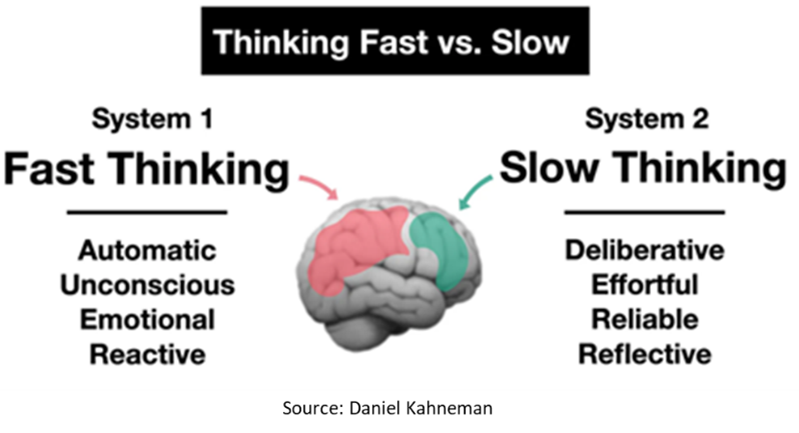
Another way to view the brain is to think about it as being two different systems. One is fast and automatic. The other is slow and manual. Despite being slow, our manual system provides an ability to override the automatic one. This is extremely important because much of what our brains do is automatic. In fact, our automatic capability is what we were born with and depended on until we developed our slower rational brain. Some studies find that 95 percent of our brain is allocated to what we do instinctively and subconsciously, leaving only 5 percent to enable our deliberate thought.
As an example of the power of our subconscious capability, we drive our automobiles without giving thought to moving our arms to turn the steering wheel or pressing our foot on the accelerator and brake pedals. We eat without having to think about moving our mouth. Neither do we give conscious thought to circumstances that immediately trigger us into physical and emotional responses. We experience physical pain without having to think about it. We experience fear, shame, anger, and joy without having to deliberate on them. We also have automatic systems like our parasympathetic nervous system that work to calm us down.
However, our slower cognitive capability can override our automatic system of thoughts and feelings. This part of our brain is slower because we have to bring it into action manually compared to our capabilities that happen without conscious effort. This deliberate cognitive ability is what we use to analyze and solve problems – both external to us and within us.
Another way to think about our brain’s two systems is that we have one we control and one we don’t. They are both part of us, but because the fast one happens automatically you might be tempted to think of it as not being you because you have little control of it. You may have said to yourself at some point, “where are these thoughts (or feelings) coming from?”
Fortunately, we have this ability to control enough of our thinking that we can override some of that which happens automatically. Yet, this doesn’t mean it is easy. Our automatic thinking can be so strong that it takes a lot of effort to override it. In extreme cases, our automatic thinking can block our ability to override it. It triggers a fight, flight, or freeze response that hijacks our physical and mental resources. It creates hormones like cortisol that cause other hormonal imbalances which cause physical changes. So, for example, while we might be aware that we have an unhealthy perspective about something, we struggle to override it. We struggle to replace negative emotions with positive ones. We struggle to intercept what seems to be natural tendencies to feel and think about certain people and circumstances in certain ways.
There are other ways people override their automatic thinking. Some do it with drugs or alcohol. Some find help by venting to friends or family. Some through counseling. Others with attention distracting activities like watching videos or sports. Some with energy draining activities such as running or going to the gym. Whatever it is, doing something can be helpful in the moment, but rarely provides sustained change. When the drug wears off or the movie ends, our thoughts and feelings return.
Rather than rely on temporary fixes or fixes that are outside of us, psychological studies confirm there is a better way. Sustainable changes in how we think happen through changes in how we think.
Studies also find that we achieve very little on our own. In particular, we need relationships. We need connection with people we trust. We need healthy attachment to others who can be our anchor in times of need. So, while controlling your thoughts is up to you, you don’t need to do it alone.
If you struggle to take your thoughts and feelings captive, and replace them with ones you control, assess how well you follow these principles:
- Know and believe that you have the ability to control your thinking. While you may not be able to control your circumstances, you can control your thinking. Explore brain science to whatever extent you need so you have the confidence to take control of yourself. Do you truly believe you can control your thinking? Are you willing and able to take responsibility for that which you feel, think, say, or do?
- Prepare your mindset. Have a desire to continually improve, be in control, and become your best self. Consider what is right, ethical, loving, honest, or whatever it is that you desire to be. Mentally picture your desired outcome and the benefits it will provide. Use these as a reminder when you become tempted to give in to your automatic thoughts. Do you know the real you that you want to be? Do you know the reputation for which you want to be known?
- As additional support on your cognitive journey, have a faith in something more than yourself. You are very important, but believing in a cause, your family, or God can sustain your motivation at a higher level than what might seem possible. What do you believe in that gives you strength and purpose to be your best self? For whom or to what are you helping by giving this your best effort?
- Your feelings are real and for a reason. They can happen automatically, but they are not without cause. They are a warning signal that alerts you to something going on. They come from your circumstances or thoughts, which include memories. Step one in controlling your thinking is to be aware of your feelings. Do you need to let some time go by to calm down enough to think about what are you feeling? Do you know what you are feeling? Can you give it a label? What is it that you are caring so much about? Can you write it down?
- Next, process your thoughts and feelings to determine whether or not they are peace giving, stress inducing, healthy, unhealthy, valid, or invalid. Assess if they are deserving of regulation or override. Are they taking you in the direction of your desired self or in a different direction? Which ones do you need to regulate or override?
- Uncover the source of your feelings and automatic thoughts. What is the circumstance that is causing them? Or what is the memory from which they are coming? What is it that you are thinking regarding the memory or circumstance? What is it that deserves your attention? What in you is causing this? Describe, discuss, debate, analyze, and understand it until you have confidence that you know the automatic thoughts you need to override.
- In many cases, the thoughts you discover and desire to address can be reframed. You can reappraise them in a different context. You can change the mental lens through which you see someone or something. For example, instead of thinking someone is your enemy, you think of them as simply having a different opinion. Or if it is a fear, you can consider it “F(alse) E(vidence) A(ppearing) R(eal).” This reappraisal is a key part of CBT (Cognitive Behavioral Therapy) which is a structured approach used by many therapists to help change how you think. Consider how you might reframe any thoughts that are unhealthy, invalid, or in need of changing. How might you think about your unwanted thoughts differently than your automatic brain is suggesting?
- Continue to use your deliberate brain to reappraise what your automatic brain tries to tell you until you make it a habit. With repetition, what you deliberately think becomes your predominate thought which can eventually become your automatic thought. But until it becomes a natural habit you have to intercept your feelings with self-awareness of what is happening so that you can override them with your cognitive ability. Are you able to intercept your automatic thoughts and feelings? Can you replace them with your reframed thoughts?
- To maintain progress, remind yourself of the benefits you are pursuing. Remember that while adversity is rarely enjoyable, it can be a great teacher. Are you learning something helpful? Are you helping something or someone other than yourself? How can you use what you are learning for a positive purpose? How might what you are doing help not only improve your thoughts but also behaviors, relationships, or other desired outcomes?
- Remember that if you are doing your reasonable best each day that you are doing your part and it is enough. No, you’re not perfect, but no one is. Maybe you’re not where you want to be yet, but just take it one day at a time. Thinking longer term can make some changes seem impossible. Think about and be grateful for the progress you’ve made. If other people are part of the problem, realize that by doing your part, you are no longer the problem. If the problem persists, it isn’t because of you. Can you not worry? Can you just do, care about, and think about whatever is in your control?
- Refer to these or other resources to help take charge of your thinking and best deal with your circumstances:
- https://alpinelink.com/docs/What_to_Do_When_Frustrated_and_Stuck.pdf
- https://alpinelink.com/docs/Overcoming_the_Stress_of_Life.pdf
- https://alpinelink.com/activating-your-ambition/
PDF version of this article: https://alpinelink.com/docs/How_to_Change_Your_Thinking.pdf
