A common goal in business, particularly in marketing, is to “capture the hearts and minds” of customers. A common trait embodied by great leaders is the ability to “speak from the heart” and “capture the hearts of the audience” when making presentations. A frequent cliché in relational communication is “having a heart-to-heart conversation.” A common idiom is feeling “broken-hearted” over something. Perhaps the word “heart” is most associated as a recurring theme in the bible such as used to “trust in God with all your heart” as part of your faith.
There are many references to the human heart you’ve probably heard and shared, but have you ever explored what it really means? The heart, of course, literally refers to the central organ in our bodies that pumps blood, but the meaning in which it is often used has nothing to do pumping blood.
Historical references to the heart were first made in antiquity thousands of years ago. Egyptian references to ib, Hebrew references to lēb, and Greek references to kardia were made about the heart as the primary organ of intellect, reason, and willpower. References to the heart encompassed the whole inner person. The brain’s role in thinking was largely unrecognized. Egyptians even discarded the brain during mummification because they did not see it as vital to personhood.
The different functions in the brain started to be recognized by Greek thinkers such as Pythagoras, Plato, Aristotle, and Hippocrates between 600-300 BC. Even then, however, their thinking didn’t diminish the importance of the heart in how it contributed to people’s identity.
Perhaps most astonishing is Aristotle’s classic framework on persuasion, Rhetoric, written in 400 BC. His view of human traits—character (Ethos), emotion (Pathos), and logic (Logos)—were still considered to reside in the heart. It was only after the transition from BC to AD that references to the heart were consistently differentiated from the mind.
Now, in our contemporary vernacular, we often refer to our thinking ability as our mind and our feeling ability as our heart. So, when we refer to our heart to reflect our feelings, we are distinguishing our feelings from our thoughts.
We know both thoughts and feelings reside in our brains rather than in the organ in our chest that pumps blood. We also know that thoughts and feelings serve very different roles. Therefore, when we say heart, we often expect people to interpret it as a reference to feelings … although it has many other meanings.
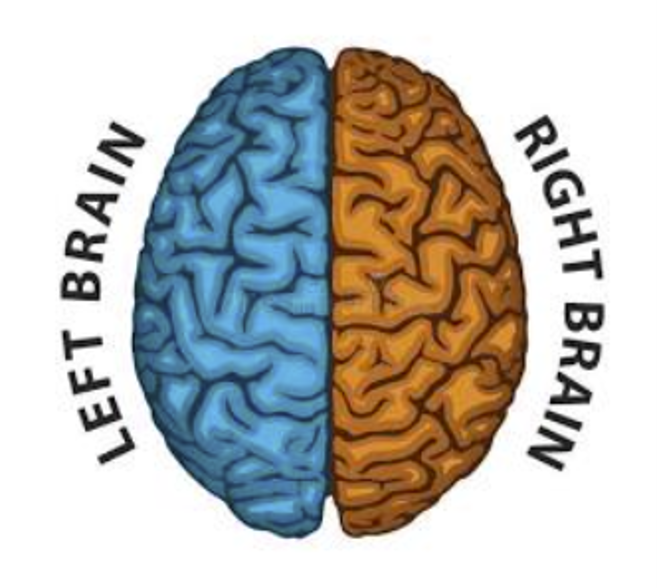
Our feelings, which are primarily processed in the right hemisphere of our brain, are associated with our emotions. These often happen subconsciously and automatically. Feelings are signals that come from our circumstances, memories, and thoughts. In contrast, our thoughts, are primarily processed in the left hemisphere of our brain. Our thoughts are derived from a conscious process that includes idea generation, analysis, problem solving, and judgment.
People have a preference to rely more on either their thinking or feeling. Many personality assessments, such as the Myers-Briggs Type Indicator (free version) help people know their innate preference. People who prefer to process information using feelings are generally more interested in people, relationships, and harmony. People who prefer to process information using logic are generally more interested in facts, projects, activities, and achievements.
When we strive to appeal to both hearts and minds, we are striving to relate to people’s thinking and feeling. We are hoping to connect with all people, those emotionally inclined as well as those who are more logical. For both, we are also trying to impact their whole being.
Great leaders, as well as great parents, pastors, doctors, friends, and successful people in general communicate in a way that connects with both sides of people’s brains. They use reasoning, theory, facts, statistics, plans, and testimonials to appeal to the logic in their audience. They use emotion, pictures, mental images, visions, desired outcomes, and stories to evoke emotion from their audience.
When you are talking or working with someone, or with many people, your audience is a combination of thinkers and feelers. Even audiences of only one person have a whole brain with both a feeling side and a logical side. Therefore, if you want to be the most effective possible in your communication, appeal to both logic and feelings. Everyone becomes engaged. Both sides of everyone’s brains are engaged. Your influence and the point you want to convey is the most impactful it can be.
As a caution, when you appeal to or refer to the heart without referencing the mind, there are many different possible interpretations. The word heart is commonly used as a metaphor for emotion and feelings like love or sorrow. Yet, it often is intended to reflect someone’s deep sincerity, instinct, authenticity, inner strength, kindness, whole being, or God’s character within them.
For example, if you say something like “we need to have a heart-to-heart conversation”, you are probably referring to the need to be authentic, but it could also be interpreted as needing to share your feelings. Or if you say something like “my heart is telling me this is not good”, you are probably expressing your instinct, but it could be interpreted as an emotion. If an emotion, it would probably be interpreted as fear, but it could also be despair, sadness, or disgust … all of which are very different interpretations.
Perhaps the most confusion related to using the word heart is when it is intended to represent our entire being. If you use the word with this intent, such as to convey a point with logic and feelings combined, you are most likely to be misunderstood. Most people’s default interpretation would be that you are referring to feelings. So, to make it clear simply say “heart and mind” instead of just “heart” if that is your intent.
There is nothing wrong with simple references to the heart and appealing to people’s emotions. In fact, studies find that people make decisions based more on emotion than on logic. However, if you are hoping to appeal to people’s whole brain and have the most influence possible, don’t forget to emphasize the mind.
Appealing to people’s emotions might get you the most social media responses. It might leave the strongest impression. It might be most satisfying, entertaining, and stimulating, but just expressing and appealing to emotions can result in a lack of action. When the emotion subsides, people can then find themselves as they were before. No real insight. No real action. No tangible change. If you want your audience to not only know why they need to do something, but also to commit to doing it, knowing how to do it, and actually doing it, don’t leave out logic.
The concept of heart has a lot of power and meaning. It is a potent part of us as well as the influence it has on others. Use it. Appeal to it. Combine it with appeals to people’ logic. If the meaning isn’t clear, ensure you surround it with supporting information such as examples that make it clear.
I hope this all makes sense to your mind and also imparts a feeling of confidence in your heart!
PDF version of this article: https://alpinelink.com/docs/Speaking_to_the_Heart.pdf.
