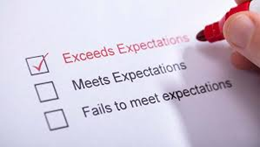
If you agree that merely meeting expectations leads to complacency, which usually doesn’t end well, then what should a person do? Should we always strive to exceed expectations? If so, what does it mean to exceed expectations? Or more fundamentally, should we use expectations to define achievement?
Or, maybe you prefer not to think about expectations.
If thinking about achieving, exceeding, and being accountable to expectations causes you angst, congratulations on being human. You are normal. You probably prefer to think about and pursue a comfortable lifestyle. That’s understandable. We are innately wired to seek comfort and pleasure. The problem becomes when we pursue a life of easy living at the expense of life’s realities.
Here is a reality people might not like, but is a reality nonetheless—we can’t just do what we want or feels good. Our bodies have expectations. Our government has expectations. Our employers, employer’s customers, and coworkers have expectations. So do our friends, family, and even our pets. Strangers too, who we bump into while driving, shopping, or playing, expect us to conform to laws and generally accepted social norms. Life has requirements and accountabilities. If we ignore them, life can become very frustrating and difficult.
This is probably not for you, but if someone you know needs any more justification for not merely seeking a life of comfort and pleasure, here are a couple of questions to consider. First, have you considered the downsides of complacency? That working as minimally as possible, especially if it is simply doing what you’ve always done before, ultimately results in falling behind. Second, have you considered that you can’t avoid change? You can either lead it or be part of someone else’s. You either jump on the wagon or get run over by it. Either way, you can’t avoid change.
Additionally, a carefree comfortable life doesn’t produce much learning. It is through challenging ourselves and dealing with adversity that we learn the most which in turn leads to improvements in ourselves and enables us to help others improve. Also, working without putting in substantial effort misses out on a sense of accomplishment. Neither do we gain much confidence in ourselves or respect from others. We don’t get a five-star rating for being complacent or achieving mediocrity. We don’t win the minds and hearts of our friends, family, clients, or co-workers by just doing what is minimally expected.
This isn’t to suggest that we need to change everything. Neither do we need to give our entire lives to our work or completely give up the personal pleasures of life. Of course, we don’t have to live in continuous misery. We don’t need to give up our core values …. unless they keep us confined to our comfort zone. We can still enjoy life as long as our lifestyle doesn’t include complacency.
If you’re unsure of your tendency to be complacent, here are a few indicators. Complacent people don’t easily embrace new ideas or possibilities. They don’t know they have a lot to learn. They are reactive rather than proactive. They don’t seek opportunities to improve themselves. They tend to avoid change when it requires extra effort or discomfort.
Hopefully you agree that doing what is minimally required isn’t the best option. That you are willing to embrace positive change which often includes exceeding past, or even existing expectations. Now, the question becomes “what should be your expectations?”
Some suggest that standards, expectations, and goals should be gargantuan. Jim Collins famously created the term BHAG – Big Harry Audacious Goals. Others, like the originator of SMART goals, George T. Doran, suggest that your goals be more realistic. Either way, expectations generally go beyond simply doing what has always minimally been done. Well defined expectations support a journey of learning, developing, achieving, and becoming better.
With goals and expectations in place, then attention turns to achieving them. Having a plan and executing it is a common approach people use. Working harder is another approach. But more fundamentally, because our mindsets precede our actions, embracing and following philosophies is what enables consistent achievement. Exceeding expectations and success, regardless of how you define it, depends on thinking differently.
Consider these philosophies when striving to achieve more and exceed expectations:
1. Think strategically. Consider the longer term and bigger picture. Think beyond what is immediately in front of you. Think a step (or two) ahead. What will be next after this? What will happen if this happens? What are the risks? What would be helpful to others in this process in which I’m a part? For more information on this, see https://alpinelink.com/docs/Is_Strategic_Thinking_Your_Blind_Spot.pdf.
2. Challenge the status quo. Know that a better way exists even if you don’t know what it is right now. Seek to find it. Don’t accept that just because something has always been done a certain way that it is the best way. You may decide to keep doing something the same way, but occasionally examine, assess, and think about what you are doing. See https://alpinelink.com/docs/Get_Out_of_Your_Comfort_Zone.pdf/.
3. Appreciate the uncomfortable. Expect change to be a challenge, at least initially, until it becomes a normal habit. Accept that being uncomfortable includes being humble and the potential embarrassment that accompanies learning. But you can do it. Embrace the difficulty. It will be worth it. See https://alpinelink.com/Docs/How_to_Take_Anxiety_Out_of_Adversity.pdf
4. Prioritize self-development. Allocate time to learning and self-improvement. Gain experience in new areas. Read, listen, study, research, and shadow people. Develop your natural gifts. Practice and apply what you learn. Strive to operate at the highest level. Become a master at something. Leverage the compounding effect of “getting into the zone” also known as flow. Pursue being the best at whatever you do.
5. Take initiative. Don’t wait for opportunities to come to you. Create them. Don’t merely react to problems and circumstances. Identify and engage them. Live and work intentionally. Prioritize your work. Work on that which is most important ….. which is rarely the easiest or most urgent. Conceive and lead initiatives rather than wait for others to do so. You don’t need a title to be a leader or proactive.
6. Imagine more. Be curious. Be openminded. Regardless of how creative you are, you can ask questions like “what can I improve?” or “what problem can I help solve?” Allow time on your calendar to let your mind wander and daydream. Schedule time with others to brainstorm new ideas, methods, and opportunities. Try new approaches. Think bigger. For example, with AI, don’t just automate what you are doing, use it to do more.
7. See help as wisdom. No one is successful all on their own. Believe that asking for assistance is a sign of wisdom, not weakness. Involve others. Seek advice. Ask for feedback, learn more about yourself, and continually use it to become the best version of yourself possible. Yes, people can be frustrating, but they can also be helpful. Give them the opportunity.
PDF version of this article: https://alpinelink.com/docs/How_to_Exceed_Expectations.pdf.
