When you think about your future, do you think about the next few months, the next few years, or end of life? Do you think about your career, retirement, family, or hobbies? Do you think about relationships or projects? Or maybe you don’t really think about the future much.
Some people have a long-term outlook. They think and plan years in advance. They are most likely to save up money for their kids’ college before they even have kids. Some have a short-term outlook. They think and plan a few months ahead. They are most likely to figure out how to pay for their kids’ college one semester at a time. Others simply get into a routine like being in a boat on a river. They just let the current of their routine take them wherever they go. They are most likely to pay for their kids’ college when the bills come due.
The difference in how people think about and plan for the future is largely an engrained personality trait. Through nature (DNA) and nurture (external influences), people develop a preferred timeline of thinking and planning. They have a default horizon which drives how far out they plan when thinking about their career, finances, family, retirement, or life in general.
Time horizons have many implications. An obvious one is that when two people with very different horizons work or live together, it can be complementary or a source of conflict. People can either gain synergy from their timeline diversity or they can find themselves frequently stuck in misalignment over what to do and when to do it.
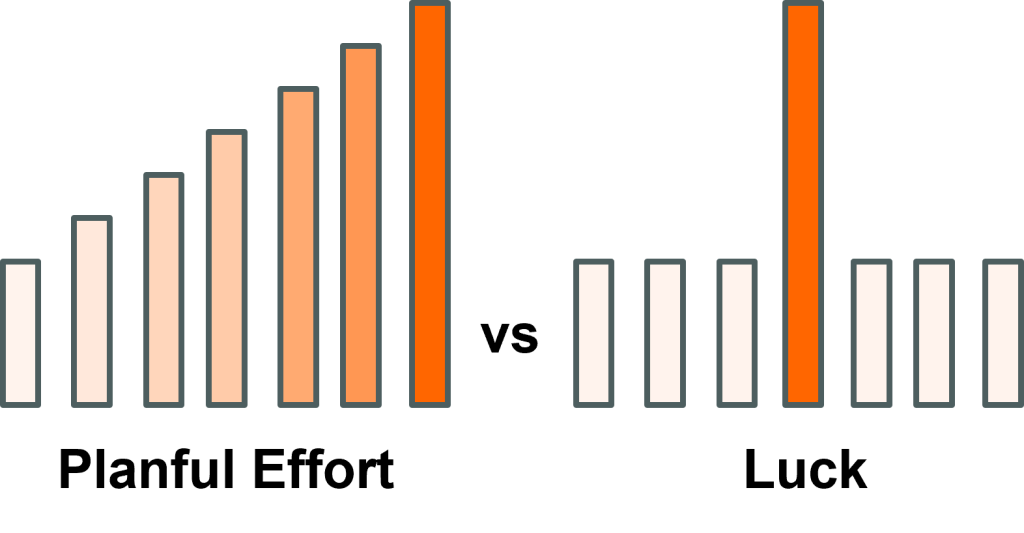
Another implication of our unique time horizon defaults is that some people are more likely to be intentional about their future and some more likely to be reactive. In other words, some people let their circumstances plan their future and some are more likely to create their circumstances. The latter put in planful effort meaning they are more purposeful and thoughtful about goal setting and achievement.
Regardless of which personality preference you have, you will be impacted by it. You will experience the circumstances that result from your planning or lack of planning. While it might seem obvious that people who do more goal setting and planning are more successful, studies find that people’s successes are often due to luck as much as anything else. Of course, this finding misses the important subtlety of luck mentioned in the quote usually attributed to Thomas Jefferson, “I’m a great believer in luck, and I find the harder I work the more I have of it.”
Statistics related to goal setting show that people are three times more likely to achieve their goals when they are written down. Statistics also show that 97 percent of people don’t have written goals and 83 percent don’t have goals at all.
However, setting goals is less important than tracking progress against them. Statistics find that only 8 percent of goals that are “set and left” are achieved. But when goals are “set and tracked”, 90 percent are achieved.
Even more importantly than setting and tracking goals is setting and tracking the right goals. Goals and plans that take you in the wrong direction are arguable worse than not setting any goals at all. There are many relationships, jobs, and projects that don’t turn out well because they weren’t the right goals to pursue to begin with. Or maybe the goals were out of priority order such as when projects or work are put ahead of family.
Here are a few principles to consider when thinking about goal setting and life planning:
- When setting goals, consider the bigger picture. What is most important in your life? Think about your purpose and who you want to be before deciding what you want to do.
- Luck plays a significant role in people’s success, but unless you are willing to accept the results of a flip of a coin, depend on planful effort instead. Luck is not a dependable strategy.
- Whether you are a short-term or long-term thinker, set specific goals and write them down if you are serious about achieving them. Mental concepts and generalities are much less reliable.
- If you want the best chance possible of achieving your goals, create plans to achieve them. Then measure and track progress along the journey of pursuing them.
- Don’t miss out on the learning that goes with planful effort. While pursuing goals might not be your aspiration, the growth and development you achieve along the way justifies it.
If you’re interested in thinking more deeply about what you want to achieve, who you want to become, and the goals you want to pursue in life, here is a individual life plan (ILP) template you can use to plan your life: https://alpinelink.com/docs/Individual_Life_Plan_template.docx.
If you are more focused on your professional development or manage employees who could benefit from an individual development plan (IDP), here is a template for that: https://alpinelink.com/Docs/Individual_Development_Planning_template.docx.
For more information on business planning, visit: https://alpinelink.com/docs/Does_Planning_Equal_Forecasting.pdf.
PDF version of this article: https://alpinelink.com/docs/Do_You_Need_a_Life_Plan.pdf.
